What you need
- The height of the object in metres – tree, hedge, wall, or a house up to the eaves or the ridge
- The place and date you want to know the shadow for
- SunPosition in the browser; a phone for the view on site
1The formula: height divided by the tangent of the sun's altitude
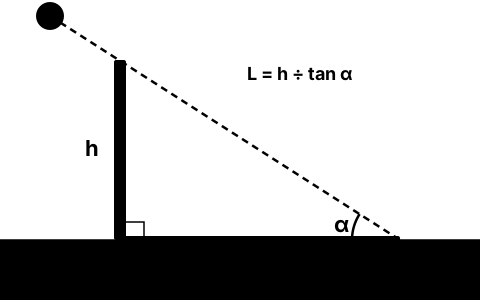
Object, shadow and sun ray form a right triangle. The object height h is one leg, the shadow length L the other, and the angle at which the sun ray meets the ground at the tip of the shadow is the sun's altitude α. It follows that L = h ÷ tan α.
At 45° the tangent is exactly 1: the shadow is as long as the object is tall. With the sun higher, the shadow gets shorter; with the sun lower, it grows fast – at 10° it is 5.7 times the height of the object, at 5° more than eleven times.
The direction is just as simple: the shadow points straight away from the sun, in the direction of the sun's azimuth plus 180°. With the sun in the south (azimuth 180°) the shadow falls to the north (0°); with the sun in the south-east (135°) it falls to the north-west (315°).
The formula assumes level ground and an upright object. If the ground falls away behind the object the shadow gets longer, if it rises the shadow gets shorter.
2Table: shadow per metre of height
The factor 1 ÷ tan α tells you how many metres of shadow each metre of height casts. Multiply it by the object height to get the shadow length. The table holds anywhere on Earth; what changes with place and season is only which sun altitudes occur there.
In southern England the sun stands at noon between about 15° (December 21) and 62° (June 21). In the morning and evening it is lower – and that is where the shadow grows fastest.
| Sun altitude | Factor 1 ÷ tan α | Shadow of a 10 m tree |
|---|---|---|
| 5° | 11.43 | 114 m |
| 10° | 5.67 | 56.7 m |
| 15° | 3.73 | 37.3 m |
| 20° | 2.75 | 27.5 m |
| 30° | 1.73 | 17.3 m |
| 45° | 1.00 | 10.0 m |
| 60° | 0.58 | 5.8 m |
| 70° | 0.36 | 3.6 m |
3Example: a 10 m tree in London
London lies at 51.5° north. At the sun's highest point – on June 21 at 13:02 British Summer Time, on December 21 at 11:59 GMT – it stands 61.9° and 15.1° high. The shadow of a ten-metre tree is then 5.3 m in summer and 37.1 m in winter. At the March equinox it is 38.4° and 12.6 m at noon.
Over the day the shadow changes more than over the year. The table gives the sun's altitude and the shadow length on the hour, computed with SunPosition for 2026. On December 21 at 9:00 the sun is only 5.5° high; the calculated 105 m shadow ends at the next building in practice.
The direction moves too: in the morning the shadow falls to the west, around noon to the north, in the evening to the east. In midsummer the sun rises in London at an azimuth of 49°, in the north-east – so the morning shadow even falls to the south-west.
| Time | June 21 (BST) | March 20 (GMT) | December 21 (GMT) |
|---|---|---|---|
| 9:00 | 36.3° · 13.6 m | 25.0° · 21.4 m | 5.5° · 105 m |
| 12:00 | 59.5° · 5.9 m | 38.4° · 12.6 m | 15.1° · 37.2 m |
| 15:00 | 54.0° · 7.3 m | 27.1° · 19.6 m | 5.2° · 111 m |
| 18:00 | 27.7° · 19.0 m | 1.3° · about 450 m | sun has set |
4Calculate the shadow for your location
Open SunPosition and choose your location – by GPS, address search or a tap on the map. Set the date and time in the top band; the time slider moves the sun across the day, and the buttons below jump to the start of spring, summer, autumn and winter.
In the “Plan” section, enter the object height. On a phone it sits on the “Sun position” page, on a computer it has its own tab. SunPosition immediately shows the length and direction of the shadow for the chosen moment and draws it to scale on the map.
The hourly table lists azimuth, altitude and shadow per metre of height for every full hour. If you need a whole month, open the monthly table under “Plan” and download it as a CSV file.
5What matters in practice
The calculation gives the length to the tip of the shadow. A tree is not a pole, though: its crown casts a broad, dappled shadow whose end fades out more softly than the numbers suggest. For a house, what counts is the highest edge facing the sun – for a pitched roof whose ridge runs across the sun's direction, usually the ridge.
For a flower bed, a patio or solar panels, duration matters as much as length: how many hours does a spot lie in shade? Move the time slider in SunPosition and watch on the map when the shadow reaches the spot and when it leaves it – ideally for December 21, June 21 and a day in spring.
For the view on site there is the camera view: it overlays the sun's arc on the camera image, so you can see whether a tree or the neighbour's house rises above the sun path.
FAQ
How long is a shadow at 45° sun altitude?
Exactly as long as the object is tall, because tan 45° = 1. In London the noon sun stands higher than 45° from April 6 to September 5; further north the period is shorter, further south longer.
Why are shadows so long in winter?
Because the sun is low: in London only 15.1° at noon on December 21. The factor 1 ÷ tan 15.1° is 3.7 – a 10 m tree then casts about 37 m of shadow, against about 5 m at noon in June.
Which way does the shadow fall?
Always directly opposite the sun: shadow direction = sun azimuth plus 180°. In the northern mid-latitudes it falls to the west in the morning, to the north at noon and to the east in the evening; in summer even to the south-west in the morning, because the sun then rises in the north-east.
How do I work out a tree's height from its shadow?
Measure the shadow, read the sun's altitude for that very moment in SunPosition and calculate: height = shadow length × tan(altitude). With the sun at 30° and a 17.3 m shadow, the tree is 10 m tall.
Sources
- NOAA Solar Calculator – calculation details and accuracy
- Jean Meeus: Astronomical Algorithms, 2nd ed., Willmann-Bell 1998